Part 1 of 5 · freeIntroduction
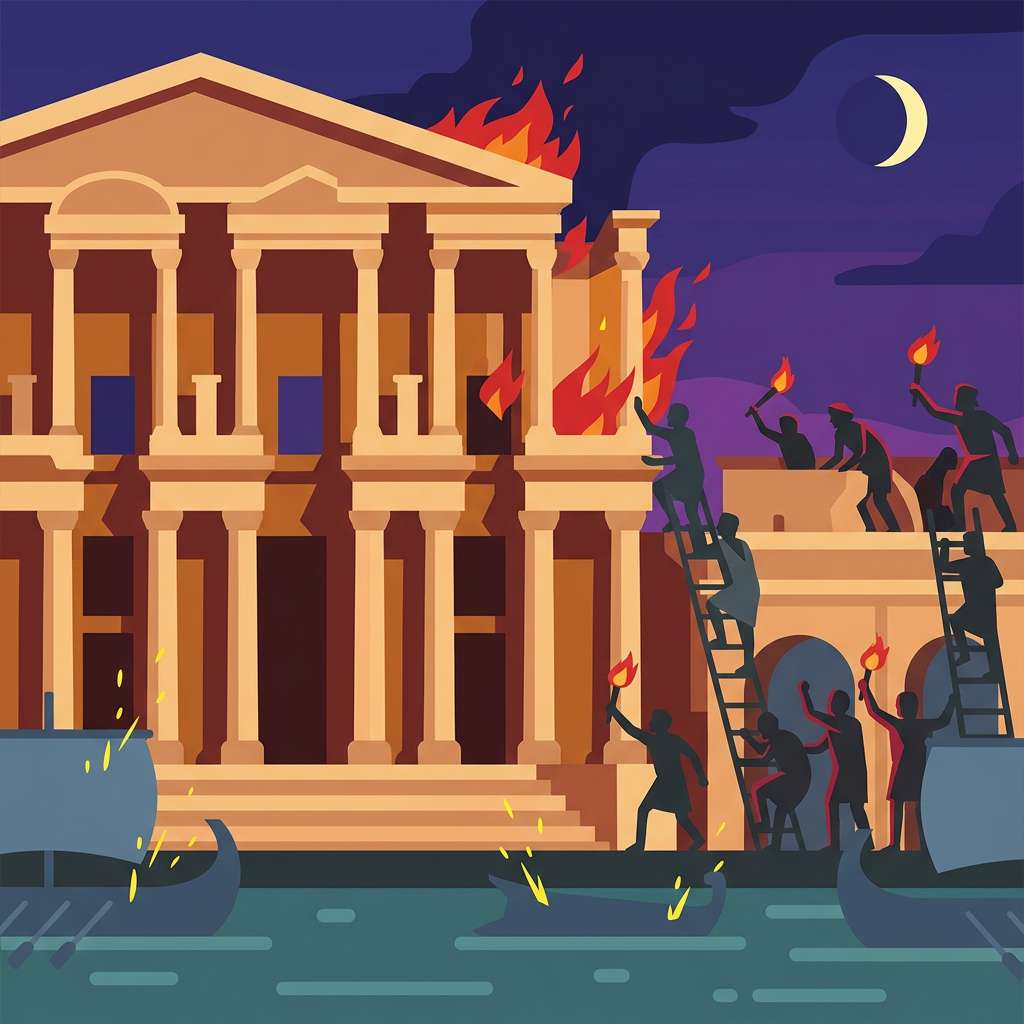
In 48 BC, Julius Caesar laid siege to Alexandria, the great Greek city of Egypt. Fire broke out in the harbor and spread to warehouses full of scrolls. Drawing on Livy, the philosopher Seneca put the loss at 40,000 volumes. That is the night remembered as the end of the Library of Alexandria.
Yet the historian Cassius Dio notes that these scrolls were not part of the main collection: they were export stock, stored near the docks. The library kept working for centuries afterward. So where does the image of a civilization plunged into darkness in a single night come from? And what if the real disaster was nothing like a fire?
The rest is in the Sophia app.The remaining parts, the open-book quiz and the full glossary. Free to start; Premium unlocks everything.
- 2A slow death, not a blaze
- 3Baghdad and Toledo: knowledge goes on
- 4A culprit for every age
- 5A myth stronger than history
Open-book quiz8 questions whose answers are in the text.
Glossary7 terms explained in a tap.
30 languagesThe same course, from French to Japanese.