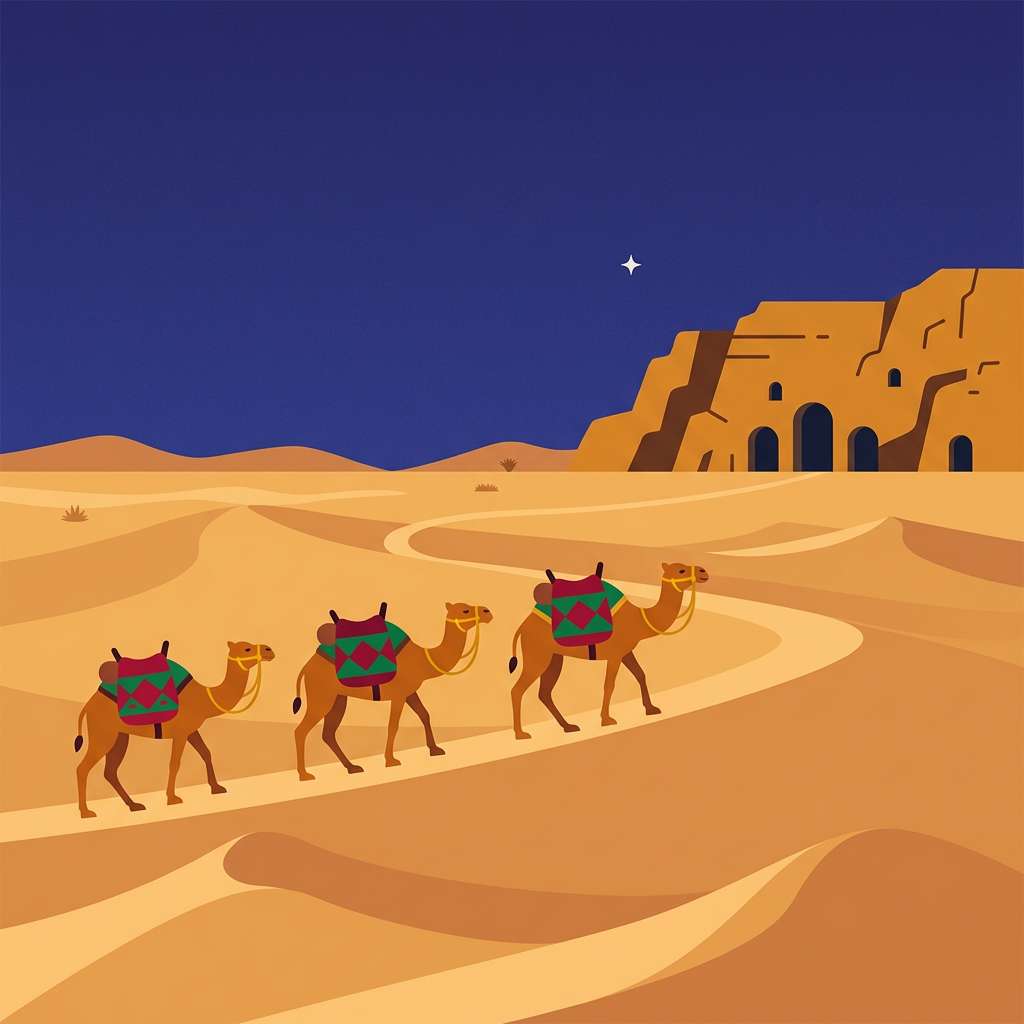
Part 1 of 5 · freeIntroduction
No emperor decreed its path, and no engineer drew its course on a map. The Silk Road was never a single road: it was a web of tracks that time turned into a legend. Why was it opened, and what did it become? Two different questions: one is about an intention, the other about an outcome that went far beyond it.
Contrary to popular belief, the route was born of military and diplomatic needs. In the 2nd century BC, Emperor Wu of China's Han dynasty sent his envoy Zhang Qian westward to find allies against the Xiongnu, nomads who threatened the north of the empire. On his return, Zhang Qian described the cities and riches of Central Asia, and above all the legendary "Celestial Horses" of Fergana.
The rest is in the Sophia app.The remaining parts, the open-book quiz and the full glossary. Free to start; Premium unlocks everything.
- 2From silk to microbes: a fatal relay
- 3The plagues that shook Rome
- 4From Justinian to the Black Death
- 5The microbial unification of the world
Open-book quiz8 questions whose answers are in the text.
Glossary7 terms explained in a tap.
30 languagesThe same course, from French to Japanese.